
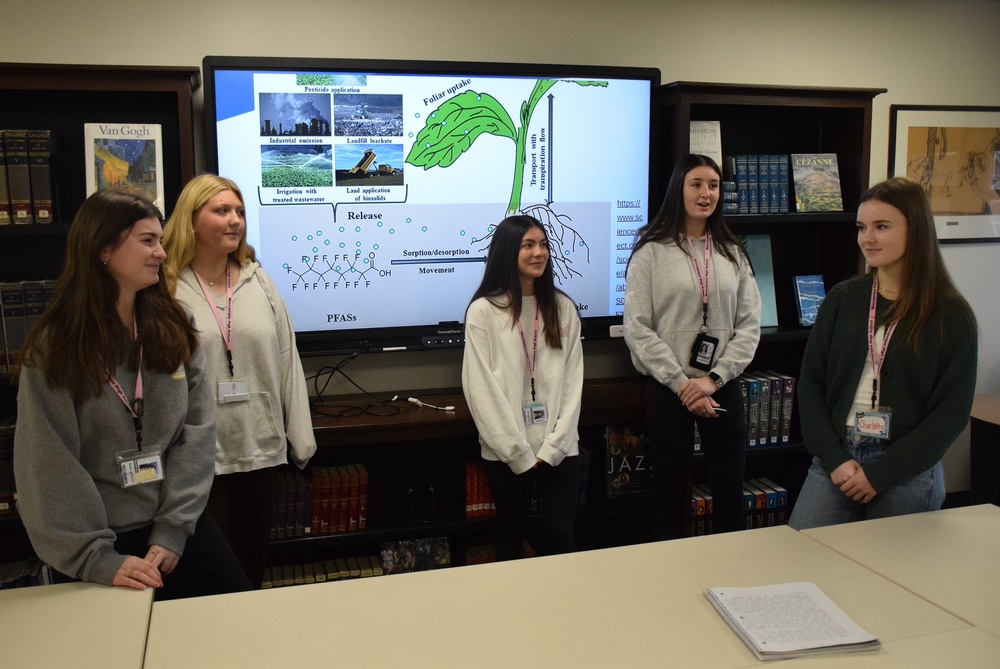
The week of Jan. 12 marked a milestone for students in Massapequa High School’s Advanced Placement Seminar courses – their first major presentations. Approximately 115 students, working in groups of four or five, showcased the findings on their research topics.
AP Seminar is the first part of the AP Capstone program, with most students taking it as their 10th grade English class. Each class is co-taught by an English teacher and a social studies teacher. The year begins with instruction on research skills, during which students are introduced to databases and learn how to identify credible sources. Following a practice presentation with feedback from their teachers, students move on to the team multimedia presentation.
Each group selects a topic, and every member of the team looks at it through a different lens. English teacher Christine Starr said that, for example, students could look at a topic from a cultural, political, social and scientific perspective. She also noted that students are expected to present potential solutions for the problems they explore.
The team of Casey Goldthwaite, Brooke McGovern, Charlotte Pachucki, Valeria Suarez and Shannon Walsh did research on PFAs, or forever chemicals, found in clothing. Their perspectives included the effects of chemicals on the environment and on consumers, as well as laws governing PFAs. After completing research on their individual components, the five sophomores came together to create a cohesive report and digital presentation.
“One of the most important skills for students to learn in high school,” Ms. Starr said, “is listening to each other and respecting different points of view.”
Participants in AP Seminar create their presentations using existing research. Their portfolio includes a paper and slideshow, and oral presentations are recorded and uploaded for the College Board, which administers the AP program.
For the second half of the year, students will work on an individual research project based on a stimulus packet. This prepares them for the self-guided projects that they complete in the second part of Capstone, AP Research, in which students select topics based on personal interest and seek to fill in knowledge gaps.