
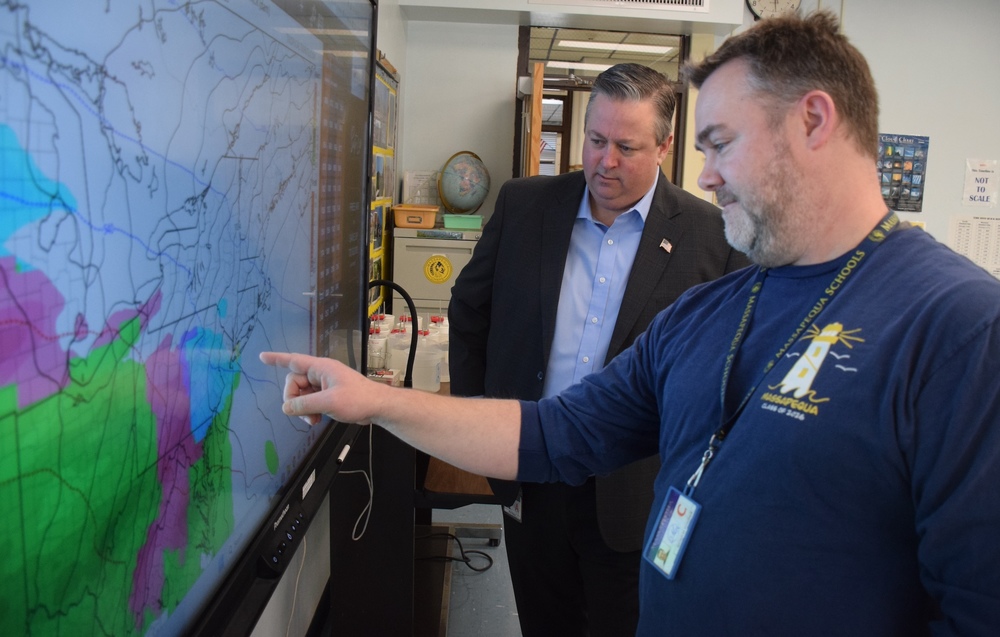
Long fascinated by weather, Massapequa High School Ames Campus science teacher Nick Donohue has sparked the same intrigue in a generation of students. He’s also the district’s go-to guy when it’s time to decide if school needs to be closed for a snow day.
This winter, his expertise has been relied on heavily, with schools closed for a day in late January following a big snowstorm and two days in late February because of a blizzard. Mr. Donohue graduated from Cornell University with a degree in atmospheric science which certified him as a meteorologist. He also received his master’s in education from Cornell and has been teaching Earth science at Ames for 24 years.
Mr. Donohue says he was kid who would always stop and watch a storm. In 1996, between his junior and senior years of high school, he went on 50-day cross-country trip to visit national parks. Getting to see different weather systems across the United States cemented his interest and started him on his career path.
He brought his interest in weather to his science classes by having students do forecasts. It was an engaging way for his ninth graders to apply the knowledge they were learning, and that led to the creation of a Meteorology elective course that launched 15 years ago.
Meteorology features an annual forecasting competition, a highly-anticipated 12-week contest in the second semester in which ninth graders apply the forecasting techniques they have learned to make real-life weather predictions locally and in cities across the country. The winner each year earns the title of Chief Meteorologist.
His roots as the district’s chief meteorologist date back to Superintendent Charles Sulc, who had then-Ames Principal Barbara Williams summon Mr. Donohue when a potential snowstorm threatened the January English Regents exam. His study of data led him to the conclusion that the storm would arrive after the exam took place and his prediction was right.
This year, Superintendent Dr. Willam Brennan has partnered with the high school’s Sports Broadcasting Club to create videos announcing snow days, with Mr. Donohue appearing in person in one and by telephone on the second to share his expertise.
Mr. Donohue said that in predicting weather, he has access to several global models of weather data, as well as using satellite images and surface observations. He also consults with many of his college friends as several became professional meteorologists. The hardest part of forecasting, he said, is that there is almost “too much data.”
About a week before a storm, he looks at patterns, positions and potential. As it gets closer, he focuses on its track before the details become clearer about three days out, including timing, intensity and precipitation type. The East Coast, he said, is prime for later-developing snowstorms, like the Feb. 22-23 blizzard, because of the warm water in the
south and cold air dropping in from the north. Surface instability and an upper air disturbance timed just right to provide Long Island with record-breaking snow totals, he explained.
“It’s a lot of pressure and it gets pretty chaotic before a big storm,” Mr. Donohue said, joking that many family and friends rely on his expertise to decide if they should keep or postpone plans when bad weather is on the horizon.
Dr. Brennan said he is often asked from other Nassau superintendents about the predictions from his on-staff meteorologist.
“Making a call for a snow day is a nerve-wracking, pressure-filled situation and knowing I have the expertise of Mr. Donohue behind our decision, I have a lot more confidence and know it’s going to be the right call,” Dr. Brennan said. “In addition to the snow day information he provides, Mr. Donohue is a phenomenal teacher with an incredible ability to connect with students and inspire them to not just love science, but learning overall. His passion comes through in every lesson and conversation.”