
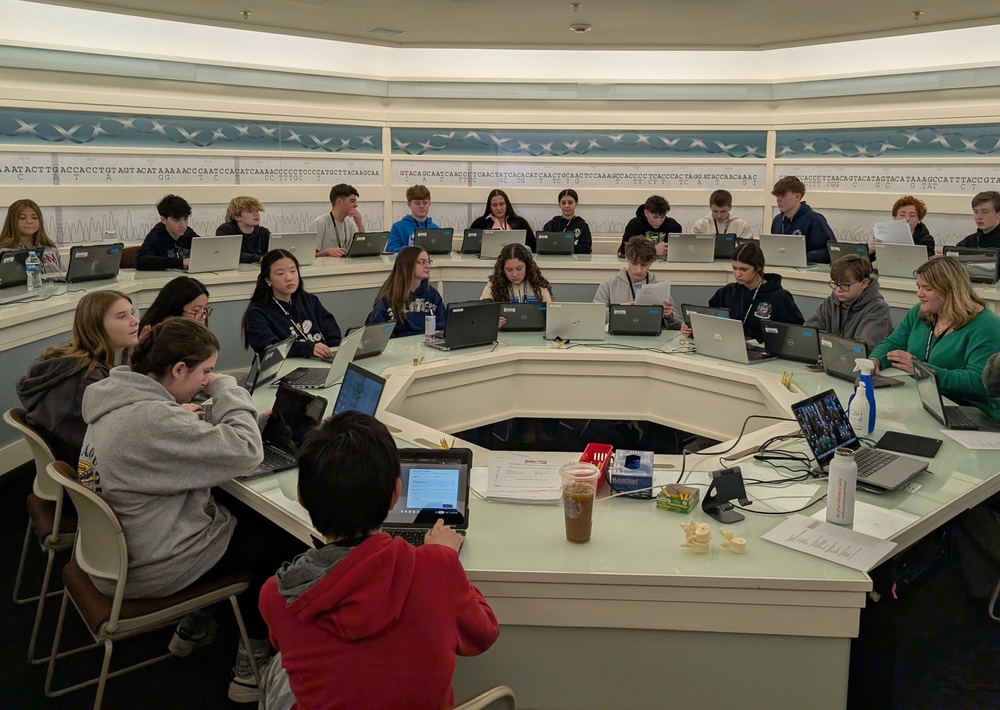
Ninth grade scientists at the Massapequa High School Ames Campus have been stepping out of the classroom and into the real world to enhance their knowledge. On Feb. 5, Science Research students made their second trip of the school year to the Dolan DNA Learning Center at Cold Spring Harbor Laboratory.
The project began in early October when ninth graders went to the stream at the Massapequa Preserve to collect samples of organisms. It is part of a multi-year study to analyze the stream’s ecosystem, as students add new data each year. Following that, they went to Cold Spring Harbor Laboratory for a DNA extraction, during which students made millions of copies of DNA of the organisms through electrophoresis to determine unique genetic codes. During their most recent visit, 34 young scientists analyzed the data to compare to known organisms using GenBank, a genetic sequence database hosted by the National Institutes of Health.
Science Research teacher August Eberling said that the ongoing data collection and DNA analysis allows students to be part of a long-term study on the stream’s biodiversity. They can see if any new or invasive species emerge or if there are any changes in the prevalence of a particular organism.
“This is a higher level of skill that most students wouldn’t even do in college,” Mr. Eberling said, noting that his ninth graders are conducting scientific studies most often done by post-graduate students and professional scientists. “It gives them experience working in a real-world situation at a much younger age than you would normally see.”
One student, following February trip, had a high number of mismatches which could mean a mutation or an unidentified species, Mr. Eberling said, noting that there is still more analysis to do. He also added that students could end up with their name on a research paper if they make a discovery worthy of publication.
Daniel Mezzafonte, curriculum associate for science 6-12, noted that Massapequa High School’s environmental science students have been involved with the Day in the Life stream study for more than 15 years at the Massapequa Preserve to support an ongoing biodiversity study. Four years ago, the ninth grade Science Research students began joining the field trip for the DNA Barcoding 101 initiative. It was another way of involving more Massapequa science students in a meaningful study of their local ecosystem, he said.
“I like how we started this hands-on project, gathering organisms and progressing throughout the year to find out what they truly are through the DNA barcoding,” ninth grader Colin T. said. “Each trip, we build onto it more. It’s just an amazing opportunity to do this through school.”
Richard F., who was in the water collecting samples of aquatic invertebrates back in October, likes how hands-on the project has been as they have gone through each step. He said it is rewarding how that work has paid off in just a few months.
“It’s very interesting seeing how all of the species interact and how one subtle difference in DNA can change how something looks or how it functions,” he said.
Colin added that he enjoys spending time in a professional laboratory and using a lot of the scientific terminology he has learned in class. He and Richard, who both want to pursue careers in science or medicine, said they are benefitting immensely from higher-level, in-depth work.
The ninth grade Science Research students will have a visit in May from Jeff Petraca, an entomologist and educator at Cold Spring Harbor Laboratory. He will support them as they work on their research papers and posterboard presentations for a June symposium at the laboratory. In addition, students are working on their independent research projects for regional competitions such as the Molloy College Science Fair and Long Island Science Congress.